Transforming organizational culture. Because it all starts with people

Organizational Culture Transformation: How to Remove Unnecessary Weight and Turn Culture into Solid Business Results
The concept of “organizational culture” has earned a difficult reputation in the business world over the years. By many down-to-earth CEOs, CFOs, or business owners, it is still perceived as the domain of “soft” HR projects-a cozy addition, a set of nice-sounding slogans printed on hallway posters, or an element of employer branding efforts. Many leaders believe that dealing with culture is a luxury one can afford only when Excel spreadsheets glow green and current sales drastically exceed projected plans.
This is one of the most serious strategic mistakes you can make in managing a modern enterprise.
Organizational culture is not a story about how much we like each other at the coffee machine. Culture is the invisible yet immensely powerful operating system of your company. It is a set of unwritten rules, habits, fears, and communication methods that dictate how your people behave when the boss isn’t looking. It is a mechanism that either drastically accelerates market strategy execution or… quietly and extraordinarily effectively sabotages every single decision made by executive management, no matter how brilliant.
If you feel that your organization has hit a wall, delivered results are no longer enough, and your team is operating at a fraction of its real potential—this guide is for you. It’s time to stop treating culture as an ideology. It’s time to view it as hard, measurable business capital and learn how professional organizational culture transformation allows you to cut away what is unnecessary and translate employee attitudes into company profitability.
1. Alarm Symptoms: How to Tell When Culture Is Inhibiting Your Growth?
Organizations rarely hit a wall overnight. It is usually a process stretched over time in which quiet warning signs are systematically ignored. Managers and business owners, consumed by daily operational battles, often fail to see that the root cause of their profitability problems or falling sales does not lie in a bad product or a tough market, but right inside a dysfunctional work culture.
The most common alarm symptoms clearly indicating that internal bottlenecks and chaos are cutting your company off from success include:
- Permanent firefighting mode: The team spins in circles, wasting massive amounts of energy reacting to immediate crises instead of deliberately and boldly executing long-term strategy.
- Noise instead of communication: Daily information flows generate more chaos, misunderstandings, and email battles than actual substantive value. Knowledge sharing between departments (e.g., production and sales) is practically nonexistent.
- Leader overload: As a CEO, owner, or managing director, you feel a destructive sense of overwhelm. You feel that all responsibility rests solely on your shoulders, and you critically lack room for strategic thinking.
- Resistance to novelty: Previous management methods stop working, and any attempt to implement a new system, procedure, or structural change meets an immediate brick wall of resistance from the team.
When an organization finds itself in this position, traditional personnel moves-such as mechanically replacing the sales director-rarely yield long-term results. Why? Because the new person steps into an old, toxic environment and is swiftly absorbed or rejected by it. Before you start moving pawns on the chessboard, you must understand that changing the rules of the game and healing the soil is the only way to regain agency.
2. The “Specificity” Myth as a Defensive Shield Against Change
When I step into an organization to diagnose the source of operational paralysis, one of the first sentences I hear in executive offices is the famous: “Marta, it’s tough here because we are very specific…” This declaration is made regardless of location, structural size, or market sector.
And naturally, it’s true-every company has its own unique history, specific market conditions, and unique team dynamics. In mature leadership, however, we must speak candidly about the trap this conviction carries. Very often, this “specificity” becomes a mental shield against stepping out of comfort zones. It serves as a universal excuse for tolerating inefficient processes, lack of decision-making, or permanent chaos.
As I prove in my article discussing why the myth of company specificity blocks organizational growth, beneath the surface of every industry’s uniqueness lie the exact same universal human and systemic mechanisms. Problems with information flow, silos, or fear of taking risks are not specific to your sector-they are specific to the nature of organizational structures. If you truly want to grow, you must stop defending your “uniqueness,” stand in front of the mirror, and start building culture based on proven, universal management patterns.
3. Process Anatomy: How to Turn Culture into Results Step-by-Step?
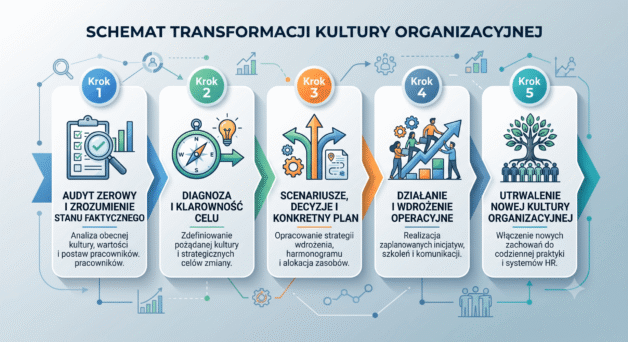
Effective organizational culture transformation doesn’t happen through revolutionary board decrees or a magic wand from HR. It is a thorough, logical, and deeply structured process that requires time, precision, and above all-leadership consistency. As a business practitioner, in my work with companies I apply a proven 5-stage action model that guarantees implemented changes genuinely take root in the company’s DNA.
Step 1: Baseline Audit and Understanding Reality
I don’t begin work with any organization without thoroughly mapping the starting point. We begin by carefully examining your current situation-real challenges, historical context, available resources, as well as hidden constraints and bottlenecks.
A baseline audit is an absolute foundation. It allows us to separate superficial opinions from hard facts and dig down to the root causes. Very often, it turns out that what executive management considered a purely sales problem is actually a deep communication breakdown at higher levels.
Step 2: Diagnosis and Goal Clarity
Once we have a complete set of audit data on the table, we move on to organizing information, perspectives, and often the emotions accumulated within the organization. This is the moment where I help leaders see more and precisely articulate what was previously unsaid or swept under the rug.
The key at this stage is absolute clarity of direction. Organizational culture transformation will not move an inch forward unless we answer why we are doing it in the first place. In my guide, I explain in detail how important business goals are in the turnaround process and why, without precise success criteria, every transformation effort turns into a waste of resources and building superficial busyness.
Step 3: Scenarios, Decisions, and a Concrete Plan
At this stage, under individually agreed principles, we develop tailored strategic solutions. I create concrete action scenarios for decision-makers-ranging from bold and revolutionary to more conservative ones. However, it is always honest, in-depth, and candid feedback.
This is a moment of truth for the leader. They must make a firm decision regarding personal commitment and executing a plan that is fully aligned with their values while remaining realistically manageable for the organization.
Step 4: Action and Operational Implementation
We translate the developed conclusions into concrete, daily steps in working with the team. We cut away what is unnecessary-simplifying complex communication processes, eliminating bureaucracy, and reorganizing accountability structures.
When necessary, I step deep into operational structures, preparing leaders and teams for autonomous, effective performance. My goal is not to make the company dependent on my presence, but to equip it with competencies that allow it to function smoothly once my role concludes.
Step 5: New Organizational Culture – Consolidation
This stage determines the ultimate success or failure of the entire project. We reinforce the implemented approach and seek systemic avenues to ensure new habits successfully “grow into” daily company life. Whether the organizational culture transformation was evolutionary or a deep revolution, consolidating changes gives the organization the best opportunity for long-term strengthening and market resilience.
In business, stabilization is a myth, which is why wise transformation must teach the organization flexibility. As I discuss in detail in my strategic manifesto, effective change management in a company means creating an ecosystem capable of constantly adapting to market dynamics instead of waiting for a crisis to force painful changes.
4. Pillars of Organizational Culture Transformation
When we simplify processes and remove unnecessary weight from the organization, we quickly reach the realization that organizational culture transformation cannot succeed without concurrent, deep work on three fundamental pillars of leadership. These form the binder that holds the structure together through every business storm.
Pillar I: Paying Off Management Debt
An organization’s culture is only as strong as the competencies of its middle managers. Unfortunately, in many rapidly scaling companies, a brilliant specialist is suddenly promoted to team lead without receiving any support or leadership “owner’s manual” at the start.
Such a First Time Manager operates in the dark, repeating bad habits from the past and generating chaos in the team. The more such points exist in the structure, the faster management debt grows in the organization. Paying off this debt through education and developing soft leadership skills are essential conditions for an organizational culture transformation to stand a chance of success.
Pillar II: Building Trust Capital
Trust in business is not a moral category-it is a hard economic parameter. When trust is lacking in a company, communication becomes convoluted and obscure, and decision-making processes are paralyzed by fear. In my analysis of the economic impact of interpersonal relationships, I show how powerful an effect trust capital in a company has on profitability and how to effectively eliminate the hidden “low-trust tax” that drastically raises operational costs in any suspicious organization. A lack of trust is costly.
Pillar III: A Culture of Wise Feedback
Organizational culture transformation requires creating a safe environment where people are not afraid to speak the truth and openly address mistakes. This demands a clear communication architecture. In my executive compendium, I describe what effective feedback in a company should look like, how to use structural models like FUKO, SBI, or the AID model which I particularly value, and how to help employees move past denial or attack so they receive feedback as a valuable developmental or motivating gift.
In my work with clients, I notice a clear pattern. We underestimate, fail to reinforce, and fail to build self-confidence-neither in employees nor in bosses. Organizational culture transformation also means understanding the role of appreciation, even for simply doing a job well. Through appreciation and noticing the individual, we send a signal that they are an important part of the team. And if we reinforce their confidence in this way, the chances increase that developmental feedback will be heard with understanding, breaking through denial, emotion, and rationalization.
5. Co-Responsibility and Navigating Paradoxes
The primary reason leaders choose to work deeply on organizational culture is the desire to build a team that takes full, mature co-responsibility for the company, rather than merely checking off daily tasks from 8:00 to 16:00. We want engaged, proactive employees who think from the perspective of the entire business’s well-being.
However, taking responsibility is not a one-sided decision by the boss-it is a two-way partnership contract that requires precise structuring. In my tool guide, I detail what wise delegation of responsibility in a team should look like and what questions both parties must ask themselves to ensure the contract known as responsibility is safe, clear, and operationally effective.
Along this journey as a leader, you must prepare for permanent collisions with opposing forces within structures. Organizational culture transformation means you will have to continuously balance employee control against autonomy, short-term goals against long-term market strategy. This is the natural business environment.
The key to winning is realizing that these opposing forces are not system errors, but paradoxes that must be managed wisely. In my systemic analysis, you will learn what separates chaos from flexibility and how skillful managing paradoxes in a company allows you to harness natural tensions as a source of creative energy and powerful process innovation.
Who Is This Path For? Is It Time for the First Step?
Organizational culture transformation is a challenge dedicated to courageous leaders who understand that culture is capital and want to build employee engagement grounded in deep meaning and solid financial performance. Organizational culture transformation might be the path for you if:
- you are in the midst of an intense structural transition-whether a complex corporate merger, multi-generational succession, or rapid business scaling,
- you want to redefine your company’s mission and values so they stop being dead slogans and become a real compass for your managers,
- you are looking for a practitioner with an empathetic yet intensely pragmatic approach who will step into your organization, cut away the noise, and translate team attitudes into tangible profitability.
If you feel your company has stalled and daily firefighting is paralyzing your leadership potential-perhaps it’s time to approach this differently than before. Maybe it’s time to stop putting off thinking about the future. Stand in front of the mirror, take the first step, diagnose your starting point, and begin wisely turning your company’s culture into business success.