Stages of organisational growth

Organizational Crisis Is Not a Failure: It’s Proof Your Company Is Growing
When established management methods stop working, projects stall, and founders or executive boards feel decision-making paralysis, the initial reaction is often panic. The question arises: “Where did we go wrong?” Yet in mature business, crisis is neither an anomaly nor evidence of incompetence. It is a natural, almost physiological stage of a growth leap. The company has simply outgrown its old clothes, and squeezing a mature organism into children’s shoes inevitably causes pain. Stages of organizational growth accompany every enterprise.
Many entrepreneurs and executives fall into the illusion that business growth should resemble a smooth, continuously rising line. In reality, every healthy organization evolves through phases of dynamic stability (evolution) punctuated by turning points (revolution) that demand discarding outdated decision-making habits in favor of entirely new capabilities.
This is brilliantly illustrated by the classic Larry Greiner Model of Organizational Growth Phases, showcasing the dynamics of evolution and revolution across a company’s lifecycle[cite: 1]. Let’s explore the stages of organizational growth—why crises are inevitable, what companies face most frequently, and how to navigate transformation without sacrificing profitability.
Stages of Organizational Growth: Greiner’s Model of Evolution and Revolution Across the Corporate Lifecycle
Larry Greiner’s framework evaluates an organization’s size against its age and the duration of subsequent growth stages[cite: 1]. Each evolutionary growth phase carries the seed of the next organizational crisis[cite: 1]:
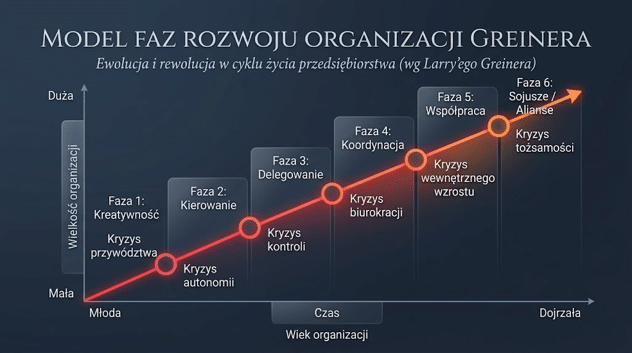
Stages of organizational growth. Graphic generated with Gemini[cite: 1]
- Phase 1: Creativity → Crisis of Leadership[cite: 1].
The initial stage of a company’s life is fueled by founder energy, intuition, and side-by-side execution. However, as the customer base and headcount expand, informal communication breaks down. Chaos ensues, triggering a crisis of leadership[cite: 1]-the urgent need for someone who can structure, budget, and manage operations rather than just “make deals.” - Phase 2: Direction → Crisis of Autonomy[cite: 1].
The company establishes initial departments, managers, and a clear hierarchy. The system works as long as decision-making stays concentrated at the top. Eventually, middle management feels disempowered, and the founder becomes a bottleneck. A crisis of autonomy erupts[cite: 1]-managers demand authority to make decisions independently. - Phase 3: Delegation → Crisis of Control[cite: 1].
Authority is delegated downward. Line managers gain momentum, but over time, business units begin operating exclusively for their own goals. The executive board loses visibility into frontline realities. A crisis of control sets in[cite: 1]-organizational cohesion fragments into autonomous fiefdoms. - Phase 4: Coordination → Crisis of Red Tape[cite: 1].
Executive leadership responds to lost control by implementing formal procedures, ERP systems, reports, and steering committees. Order returns, but with it comes rigid bureaucracy. Procedures become more important than the customer. The company is paralyzed by a crisis of red tape[cite: 1]-loss of agility and retreat into paperwork. - Phase 5: Collaboration → Crisis of Internal Growth[cite: 1].
Bureaucracy gives way to cross-functional teamwork, trust capital, and matrix project structures. Yet when internal innovation and operational efficiency peak, the firm collides with a crisis of internal growth (saturation)[cite: 1]-further scaling requires looking beyond its own walls. - Phase 6: Alliances & Partnerships → Crisis of Identity[cite: 1].
Growth occurs through mergers, acquisitions, joint ventures, and strategic market alliances[cite: 1]. However, this brings a clash of disparate organizational cultures, sparking a crisis of identity[cite: 1]: who are we truly after the merger?
What Growing Companies Face Most Frequently: Frontline Market Practice
In my strategic advisory, board-level, and interim practice, I observe that companies-especially scaling SMEs and family-owned enterprises-frequently get stuck at the intersection of Phases 1, 2, and 3[cite: 1]. That is where the most painful executive dilemmas unfold:
- The Founder’s Trap and Fear of Relinquishing Control: The owner claims they want an autonomous team, yet personally signs off on every expense and initiative. This creates passive executors rather than accountable leaders, accumulating hazardous management debt.
- Silo Warfare After Delegation: Sales promises the moon to clients while operations falls behind on delivery. The absence of a shared P&L and mutual trust paralyzes day-to-day operations.
- The Plague of Unproductive Meetings: In the absence of mature processes, scheduling meetings becomes a default alibi for avoiding decision-making risks. Instead of taking decisive action, organizations drown in debate, requiring intervention through effective meetings and a clear communication architecture.
- The Gap Between Declarations and Execution: Rolling out incentive schemes or slogans about “innovation” while the team lacks the essential foundation of trust capital in business.
How I Work with Organizational Crises: A Proven Methodology
An organizational crisis cannot be resolved with superficial workshops or another motivational speech. Stepping into an organization as a Strategic Advisor, Interim Manager, or Fractional Leader, I base my intervention on four pillars:
1. Diagnosing the Growth Stage and Removing Blame
I release the executive board from the feeling of failure. Using hard data, I demonstrate precisely where the company stands in its lifecycle. What worked brilliantly with 20 employees is structurally incapable of functioning with a team of 100. Realizing that growing pains stem from the mechanics of scale rather than bad intentions unlocks genuine, constructive dialogue.
2. Getting Close to the Process (GEMBA Walk)
I don’t rely on polished slide decks. I walk the production floor, observe customer support, speak directly with frontline professionals, and listen to interdepartmental friction. I separate opinions from hard facts to identify genuine decision-making bottlenecks.
3. Rebuilding the Accountability Architecture
I help define clear boundaries of autonomy. We clarify what stays at board level and what must be handed over to line leaders. We leverage precise business goal setting and the principles of psychological safety-employees must know they have both the authority to make decisions and the safety to learn from errors without fear of retaliation.
4. Implementation and Preparing the Team for Independence
Whether operating on a subscription basis (Fractional Leadership) or a time-bound transformation project (Interim Management), my objective is to establish institutional self-sufficiency. I implement operational tools, stabilize habits, mentor successors or newly appointed directors, and transition the steering wheel to internal leadership. Growth stages are natural-I help organizations master them.
Which Phase Is Your Company in Today?
A crisis doesn’t ask for permission—it arrives whenever business scale outgrows the existing rules of the game. You can attempt to wait it out, risking margin erosion and executive turnover, or leverage it as your most powerful catalyst for building a mature, resilient enterprise. Every business navigates the stages of organizational growth.
If existing management methods have stopped delivering results and daily operations feel like non-stop firefighting-let’s talk. Let’s diagnose your current stage of growth and navigate this transformation safely together.